

Why Good Posture Is the Foundation of Pain-Free Living
Posture is not about sitting up straight. It is about how your body distributes load across every joint, every hour of every day — and the cumulative cost of doing it badly.

The advice to "sit up straight" is well-meaning but almost entirely useless. It tells you the destination without telling you how to get there — and for most people, trying to maintain 'good posture' through willpower alone lasts about forty seconds before the muscles fatigue and the old pattern reasserts itself.
Real postural correction is not a matter of effort. It is a matter of structure: making the joints mobile enough and the muscles strong enough that good alignment is the path of least resistance, not the path of most effort.
What posture actually is
Posture is the sum of every joint's position at rest and in movement. It is shaped by your movement history — the sports you played, the desk you sit at, the injuries you have compensated around, the shoes you wear. By the time most adults reach their thirties, their resting posture is a fairly accurate map of their movement biography.
Common patterns include:
- Forward head posture — the head sits in front of the spine rather than above it; driven by screen use, reading, and driving
- Rounded shoulders (protracted scapulae) — the chest caves and the upper back rounds; driven by typing, scrolling, and prolonged sitting
- Anterior pelvic tilt — the pelvis tips forward, exaggerating the lumbar curve; driven by tight hip flexors and weak glutes from sitting
- Flat lumbar spine — the natural lumbar curve is lost; common in people who sit with a posterior pelvic tilt or have chronic lower back pain
- Knee valgus (knees caving inward) — driven by weak hip abductors and altered foot mechanics
None of these patterns exist in isolation. They are all connected — change one and the others shift. This is why generic posture advice ("pull your shoulders back") often makes things worse: it corrects one joint without addressing what is driving the problem upstream or downstream.
Why posture matters beyond aesthetics
The visual dimension of posture is the least important part. What matters is load distribution: which joints are being compressed, which muscles are chronically shortened, and which structures are being asked to do jobs they were not designed for.
Posture is not cosmetic. It is the blueprint that determines which tissues accumulate wear — and at what rate.
A forward head posture of just 25mm increases the effective load on the cervical spine from 5kg to approximately 12kg. Multiply that by 16 waking hours and 365 days, and you understand why cervicogenic headaches and disc degeneration are so common in desk workers. It is not genetics. It is accumulated mechanical loading.
What changes posture — and what does not
Posture does not change from reminders. It changes from two things: mobility (can the joint move into the correct position?) and motor control (does the nervous system know how to get there and hold it?).
If your thoracic spine is stiff, it cannot extend, so pulling your shoulders back just compresses the lower back. If your hip flexors are short, your pelvis will tilt forward regardless of how often you remind yourself to stand tall. The mobility deficit must be addressed first. Then the motor pattern can be re-educated. Then the strength to hold the pattern under load can be developed.
This sequence — mobility first, activation second, integration third, load fourth — is the corrective exercise framework. It is methodical, not motivational.
How we assess and correct posture at WSA
Our postural assessment takes approximately 60 minutes. We look at static alignment from the front, side, and back, then watch you move through a series of functional patterns: a squat, a hip hinge, a push, a pull, a single-leg stance. From those observations we identify the joints and muscles driving your postural pattern, and we design a programme around those specific findings.
The programmes typically run 6–12 weeks. Within that period, most clients notice reduced pain and tension within the first three weeks — the structural changes come later, but the functional improvements come quickly because the nervous system responds fast to accurate input.
If you want to know where your posture stands, take the free posture screen — a five-minute online questionnaire that gives you a functional assessment report. Or book a full assessment if you are ready to start.
Ready to
get started?
Take the free posture screen — instant results — or book directly with our team in Nairobi.
Keep going.

Lower Back Pain That Won't Go Away: Why It Keeps Coming Back and What Finally Fixes It
If your lower back pain disappears and returns on a predictable cycle, the problem is not the flare-up — it …
Read →
Why Your Feet Are the Foundation of Your Whole Body's Health
Most chronic pain in the knees, hips, and lower back starts at the foot. Here is what corrective movement science …
Read →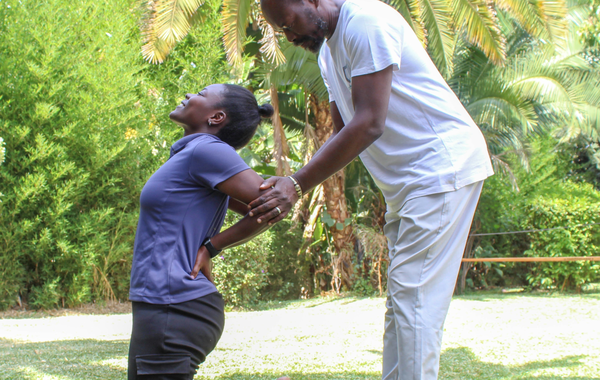
The Best and Worst Exercises for Back Pain (Ranked by a Corrective Therapist)
Not all exercise helps back pain. Some of the most commonly recommended movements make the underlying pattern worse. Here is …
Read →