

Personal Trainer vs Corrective Exercise Specialist: Which Do You Need?
Both will make you train. Only one starts by finding out why your back, knees or shoulders keep complaining. Here is how to choose, and when you need both.
Search for a personal trainer in Nairobi and you will find hundreds: in gyms, in estates, on Instagram. Many are excellent. But a lot of people who hire one end up stopping after a few weeks, not because they lack motivation, but because their back, knees or shoulders start hurting.
That is the gap a corrective exercise specialist fills. This article explains the difference and helps you decide which you need first.
What a personal trainer does
A good personal trainer helps you reach a fitness goal: lose weight, build muscle, get fitter for a race or a wedding. They design workouts, push intensity, keep you accountable and track progress. If your body moves well and nothing hurts, a personal trainer is often exactly what you need.
What a corrective exercise specialist does
A corrective exercise specialist starts one step earlier. Before adding load, they assess how you move: posture, joint mobility, which muscles are switched off, how your feet and hips behave when you squat, step or bend. Then they correct the patterns that cause pain or limit you, and only then build strength and fitness on top.
The aim is not just a harder workout. It is a body that can take a harder workout without breaking down.
The key differences
- Starting point. Personal training starts with your goal. Corrective exercise starts with an assessment of how you move.
- Who it suits best. Personal training suits people who already move well and are pain-free. Corrective exercise suits people with recurring pain, stiffness, poor posture, old injuries, or who have stopped training because something hurt.
- What a session looks like. A personal training session is mostly workouts, sets and reps, cardio. A corrective session mixes mobility, activation and hands-on release with strength work, progressed toward performance.
- How progress is measured. Personal trainers measure weight, reps and times. Corrective coaches also measure posture, range of motion and pain, retesting against your first assessment.
- The risk if it is the wrong fit. Loading a faulty pattern can turn into an injury. Corrective work alone may under-challenge someone who is already moving well.
You cannot out-train a movement problem. If something hurts every time you train, more training is not the answer. Better movement is.
You probably need corrective exercise first if
- Your lower back aches after squats, deadlifts or long runs
- Your knees hurt on stairs or when you squat
- Your shoulders click or pinch when you lift your arms overhead
- You have had to stop training more than once because of pain
- You sit for most of the day and feel stiff when you start moving
- You are coming back after an injury, a pregnancy or a long break
You can probably go straight to a personal trainer if
- You move freely and train without pain
- Your goal is mostly performance: speed, size, weight loss
- You have no history of recurring injuries
Why not both?
For many people the best plan is both in one: corrective work first to fix the foundation, then progressive strength and conditioning with the same coach, who knows your body and what to watch for. That is how we work at Wellness Solutions Africa. Our coaches are trained in corrective exercise, so your plan moves from fixing to performing without changing trainers.
How it works with us
- Assessment. A 60-minute postural assessment maps how you move and what is holding you back.
- A pathway. We match you to Pain Relief, Posture Reset or Strong Feet & Movement.
- A monthly membership that fits how often you want to train with us: from a home plan with monthly check-ins (Hybrid), to coaching three times a week (Premium), to most days of the week (Elite).
Want one-to-one sessions first? Book a one-to-one corrective session, in person in Westlands or online.
Not sure which you need? Take the free 60-second posture screen, or book an assessment and we will tell you honestly.
Ready to
get started?
Take the free posture screen — instant results — or book directly with our team in Nairobi.
Keep going.
Sciatica in Nairobi: Why the Leg Pain Keeps Coming Back, and What Helps
Sciatica is a symptom, not a diagnosis. Here is why that burning, shooting pain down the leg keeps coming back, …
Read →
Lower Back Pain That Won't Go Away: Why It Keeps Coming Back and What Finally Fixes It
If your lower back pain disappears and returns on a predictable cycle, the problem is not the flare-up — it …
Read →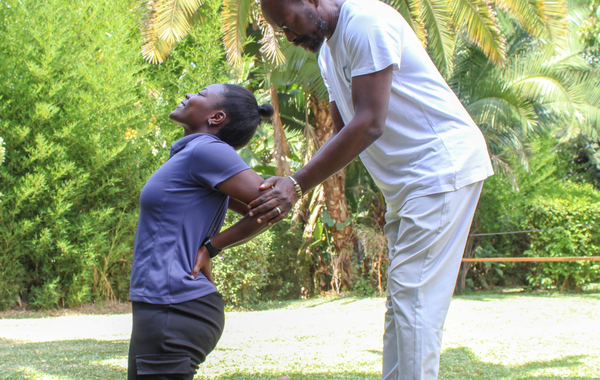
The Best and Worst Exercises for Back Pain (Ranked by a Corrective Therapist)
Not all exercise helps back pain. Some of the most commonly recommended movements make the underlying pattern worse. Here is …
Read →